Hey there — ever stood next to a forklift charging station and wondered why sometimes the charger hums quietly, almost like it’s taking it easy, and other times it’s pushing power hard enough to almost make the lights flicker? I get it; for a long time, I worked right alongside my team building forklift chargers for warehouses, so that little difference used to bug me. It’s not just random speed — that “smart” part of a smart forklift charger is basically the reason your whole warehouse runs without downtime. Let’s break this down like we chat on the shop floor, no fancy textbook jargon. Forklift Charger
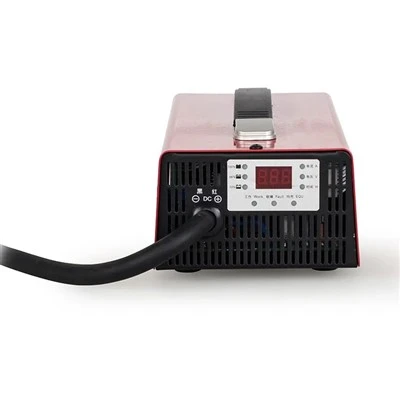
First off, let’s set the scene: forklifts don’t use regular car batteries — they’re big, heavy-duty lead-acid or lithium-ion packs, designed to haul pallets all day long. A “dumb” charger back in the day would just plug in, crank out a set voltage, and keep going until the battery was full, no matter what. That’s a quick way to kill a battery’s lifespan — I’ve seen it happen; some customers used to come back with batteries dying in a year because they overcharged them or charged too fast when the battery was half-dead. Smart chargers fix that by constantly adjusting their charging rate, and they do it using three core tools: sensors inside the charger, battery data that they pull in real time, and a little brain (we call it a microcontroller, but it’s just a tiny, super fast computer) that crunches all that info.
Let’s start with the sensors. The most basic one is a voltage sensor. When a battery’s totally dead, its voltage is low — like, a 48V forklift battery might read 42V when it’s drained. The charger picks that up immediately, and knows it can push a higher current (that’s the rate of power flow, basically) because there’s less resistance in a dead battery. But as the battery fills up, voltage creeps up — once it hits like 56V for that same 48V pack, the sensor tells the charger to slow down. No more cramming power in, that’s how you overheat the plates in lead-acid batteries, or fry cell connections in lithium ones.
Then there’s a temperature sensor, and this is the big one. Warehouses are tough on gear — it might be 90°F in the loading bay in summer, or close to freezing in a cold storage area. A battery hates extreme temps. If you plug a battery in at 30°F, even if it’s half-dead, cramming fast power will make its internal temp spike to unsafe levels — that’s a fire risk, for one, and it’ll also kill the battery. The temperature sensor on our chargers (and all good smart ones) watches the battery’s temp every 10 milliseconds. If it gets too hot, say over 115°F, the charger doesn’t just turn down the rate — it might pause charging for a minute, let the battery cool, then pick back up at a slower speed. I remember one customer had a cold storage warehouse; they used to charge their forklifts too fast because they were on tight schedules, and their batteries were dying every 18 months. Once we installed smart chargers with temp sensors, their battery lifespan jumped to 3 years, and they had zero overheating scares. That’s not a sales line — that’s something we saw with our own eyes.
Wait, and for lithium-ion batteries (which more warehouses are switching to now), there’s also current sensors. Those track exactly how much power is going into each cell of the battery, not just the whole pack. Each cell has to stay balanced — if one cell takes 2A and another takes 5A, the weak one will overcharge and die. Smart chargers adjust the rate per cell, not just the whole charger. That’s why lithium-ion smart chargers are a little pricier, but they save way more on battery replacements long-term.
Now, how do they actually adjust the rate? Let’s make this simple. Think of the charging rate as a water hose: if your bucket’s totally empty, you can turn the hose all the way on and fill it fast. Once the bucket’s 90% full, you turn the hose down to a trickle, so you don’t spill water or damage the bucket. That’s exactly what a smart charger does. The microcontroller (the “brain”) runs a simple, never-ending loop: every couple seconds, it checks the voltage, temperature, and current from the sensors, then compares that to the battery’s spec sheet (we pre-load all the right specs for every forklift battery we make chargers for) and adjusts the output voltage or current accordingly. No human has to touch it — it all happens automatically.
There’s also a thing called “charge stage detection” that’s key here. Most smart chargers go through three stages, and each stage has a different rate. The first stage is bulk charging: that’s the fast charge, usually 80% of the total power the charger can push. It only runs when the battery’s really drained, and it stops when voltage hits a set point (again, checked by sensors). The second stage is absorption charging: now the charger slows way down, holding a steady voltage, to top off the rest of the battery without overcharging. For lead-acid, this is super important — over-absorbing will cause gassing, which eats away at the battery’s water and plates. The third stage is float charging: once the battery’s 100% full, the charger drops to a tiny trickle, just enough to keep the battery topped off until the forklift is used. If the battery drains a little over time, the charger will jump back to absorption, no need to unplug and replug. Dumb chargers never did this third stage — they’d either keep cranking or shut off completely, leaving the battery to slowly drain if left plugged in for days. That’s another thing we fixed for customers: some guys used to leave chargers plugged in over the weekend, and their batteries would be dead on Monday because the dumb charger shut off, and self-discharge drained the pack. Smart chargers stay on float, so the battery’s ready to go whenever.
Wait, I should mention one more thing — some newer smart chargers talk to the warehouse management system (WMS), right? Like, if your WMS tells the charger that a forklift is only needed for 2 hours, not a full shift, the charger can adjust its rate to get the battery to 80% super fast, instead of waiting for a full charge. That’s a game-changer for warehouses with tight schedules, because you don’t have to wait 8 hours for a full charge — you can get a quick top-off when a forklift is between runs. We work with a lot of WMS providers, so our chargers can sync up with those systems no problem, no extra setup hassle.
Let’s talk about what happens if a charger can’t adjust right. I’ve seen a customer in a manufacturing plant run into this years ago: they bought cheap “smart” chargers from a no-name brand. The sensors were garbage — they didn’t track temperature right, so in summer, the chargers would keep cranking fast, and a couple of batteries swelled up (that’s a bad sign, by the way — it means internal damage) and had to be replaced. The sensors in those cheap chargers only updated once a second, not every 10 milliseconds, so they missed temp spikes. That’s why it matters who you buy your charger from — not all smart chargers are created equal. The adjustment only works if the sensors are accurate and the brain is fast enough to process the data.
So, to wrap up the how-to: it’s a loop of real-time sensor readings, a microcontroller that compares those readings to battery specs, and three distinct charge stages that adjust speed automatically. No manual dials, no guesswork, just a charger that works with the battery, not against it.
For us — we’re forklift charger suppliers, not the type to push junk — we build every charger with industrial-grade sensors, not the cheap ones that die after a year. Our microcontrollers run on code we’ve tweaked over 15 years, fixing all the kinks we saw in the field. We test every charger before it leaves our shop, so when you plug it into your forklift, it’s already calibrated for your battery, no extra setup.

If you’re tired of batteries dying too fast, or downtime because chargers are either too slow or frying your packs, hit us up to chat. We can walk through your specific forklift fleet, your warehouse temps, whatever, and find a charger that fits. No sales pitches, just guys who’ve been in this industry for decades, know the ins and outs, and want to help you keep your warehouse running smoothly.
Lithium Battery Charger References:
- Battery University. (2022). Understanding Lead-Acid Battery Charging Stages. Cadex Electronics Inc.
- IEEE Transactions on Industrial Electronics. (2021). Smart Charging Algorithms for Lithium-Ion Forklift Batteries. Institute of Electrical and Electronics Engineers.
- Material Handling Industry of America. (2020). Best Practices for Forklift Battery Charging and Maintenance. MHI.
Huizhou Qiangfeng Power Technology Co., Ltd.
As one of the most professional forklift charger manufacturers and suppliers in China, our products have good reputation in the market. We warmly welcome you to buy customized forklift charger made in China here from our factory. If you have any enquiry about quotation, please feel free to email us.
Address: No.28, Hu’ao Avenue, Shiwan Town, Boluo County, Huizhou City, Guangdong Province
E-mail: Komco@Jinlidianqi.cn
WebSite: https://www.qfautobatterychargers.com/
