If you’ve ever waited impatiently for an empty escalator step after arriving at a mall, airport, or office building, you might have glanced down at that metal tread and thought: could this step actually break under my weight? Or if I’m with a group of friends, can four of us stand on one single step without causing issues? As an escalator supplier with over 15 years in the game, I get these questions all the time—from curious passengers to building managers pulling permits, from maintenance techs troubleshooting odd wear patterns to event coordinators planning big crowds in convention centers. Today, I’m pulling back the curtain on the technical side of escalator steps, answering that big question: Do escalators have a weight limit per step? Spoiler: it’s not just a random number pulled out of thin air—it’s a carefully calculated, regulated standard that affects every part of an escalator, from the step’s metal frame to the motor that powers the whole thing. Escalator

Let’s start with the basics, so we’re all on the same page. An escalator isn’t just a moving set of stairs. Every step is an individual unit, connected to a chain that runs along the entire loop of the escalator, turning at the top and bottom landing to fold back under the tread area. When you look at a step, you see three main parts: the tread (that’s the flat part you stand on), the riser (the vertical part that keeps your feet from slipping off the back), and the step’s frame, which houses the wheels that ride along the tracks inside the escalator’s truss. Now, each step is designed to carry weight, but that weight isn’t just the people standing on it—it’s part of a whole system, so the per-step limit ties back to how the entire escalator is engineered to work.
First, let’s get the regulatory stuff out of the way, because this isn’t something manufacturers make up. Around the world, two major standards set the rules for escalator safety: the American National Standards Institute (ANSI) A17.1, which covers all passenger conveyors in the U.S., and the European Norm EN 115, which is used across most of Europe and adopted in many other countries. Both standards specify a minimum load capacity for escalators, but they break that down into per-step numbers that are non-negotiable. For example, ANSI A17.1 sets a maximum load of 1000 pounds per linear foot of escalator width, which translates to roughly 250 to 300 pounds per standard 32-inch-wide step. Wait, hold on—let me make that concrete for you. A typical retail or office escalator is 32 inches wide, so each step has a rated weight limit of about 275 pounds. A wider, heavy-duty airport escalator that’s 48 inches wide might go up to 400 pounds per step, because it’s built to handle larger crowds moving more quickly. That number isn’t just for the step itself, though—it’s the maximum load that the entire step assembly can safely support at any point, including when the step is at its most stressed spot.
Let’s talk about why that number matters beyond just the step. The step is connected to two roller chains that pull it along. If a step has too much weight on it, the chains have to work harder to carry that load, which speeds up wear on the chain links and the sprockets (the gears that turn the chains at the top and bottom). Over time, that extra strain can lead to premature chain failure, which is a huge safety hazard—no one wants a chain snapping mid-escalator ride. Also, the tracks that the step’s wheels run on are engineered to distribute the load evenly. If one step is carrying way more than its rated limit, the tracks can develop dents or uneven wear, which causes steps to wobble or rub against the side panels. I’ve seen this firsthand on older escalators in crowded malls where the original rated limits were stretched over decades of heavy use. A few years back, we got a service call for a mall in Ohio where steps were scratching the side of the truss—inspection found that groups of four to five teens were piling onto a single 32-inch step just to take a silly photo, repeatedly, over a month. The excess load bent the step’s frame, which then dragged on the track, and we had to replace 12 steps and resurface the tracks before the escalator could safely operate again. That little stunt cost the mall thousands of dollars in downtime and parts, all because they didn’t realize how much stress that silly act put on the system.
But wait—what about dynamic vs. static load? That’s another key point most people (and even some small facility managers) miss. The rated weight limit per step is a dynamic load limit, right? Because when you’re walking onto an escalator, you’re moving, not standing completely still. Static load is what you’d measure if you set a 275-pound box on a step and left it there all day, but dynamic load accounts for the extra force of a person stepping on or off, leaning forward, or even jumping a little (yes, people actually do that on escalators). The standards build that dynamic factor right in, so the per-step limit is already accounting for that extra movement. That’s why you might see a 275-pound limit on a step, and if you weigh 260 pounds with a small backpack, you’re well within the safe range—you’re not just a stationary box, so the actual force on the step is lower than your total static weight. That’s a common misconception: people think if they’re 280 pounds, they can never stand on an escalator step, but that’s not true, as long as they’re not putting sudden, excessive force on the step. The limit is there to prevent sudden, abnormal loads, not to shame people for their weight.
Now, let’s get into how steps are actually built to meet these limits. When we manufacture escalator steps, we use high-grade carbon steel for the frame, not the thin aluminum you might see on a cheap outdoor conveyor or a moving walkway. The tread itself has a non-slip surface, but underneath, there are reinforcing ribs that run along the length of the step, and cross-braces that connect the tread to the riser and the wheel assembly. For standard 32-inch steps, we test each one to 500 pounds of load before they leave our factory—double the rated limit—to make sure they won’t fail under extreme conditions. That testing is required by both ANSI and EN standards; no step can be shipped out without passing that load test. I remember a few years ago, we had a custom order for a metro system in Tokyo that wanted extra-heavy-duty steps for a line that carries 100,000 passengers a day during rush hour. We engineered those steps with thicker steel frames, and we tested them to 700 pounds each—even though their rated limit was only 350 pounds per step. That order saved them from having to replace steps every two years, which would have been a huge hassle for a busy metro line.
But here’s another thing: the weight limit per step isn’t just about the step itself. It affects the entire escalator’s load capacity. The total weight of people on the escalator at any time is calculated based on the number of steps and the per-step limit. For a 32-inch escalator with 50 steps, that’s a total rated load of roughly 13,750 pounds for the entire moving system. If someone puts too much weight on one step, it doesn’t just risk that step—it can throw off the balance of the entire chain. Escalators are balanced to distribute weight evenly; if one step is carrying extra load, the chain can pull at an angle, which strains the motor and the gearbox. I’ve seen small motors burn out because a building management company allowed food trucks to park their entire load of supplies on a single escalator step during setup. They thought, “The whole escalator can hold X number of people, so it can hold my 1000-pound load,” but they didn’t account for the fact that all that weight was on one step, not spread out evenly across the whole length of the escalator. That mistake cost them $12,000 to replace the motor and the gearbox assembly—way more than it would have cost to use a freight elevator.
Now, what about common myths? I hear all the time that you can “feel” the step get weaker as it ages, or that older escalators don’t have per-step limits. That’s not true. Every escalator that’s been manufactured in the last 50 years, anywhere in the world, has a rated per-step weight limit stamped on the step’s frame, usually on the underside where you can’t see it without kneeling down. Even older escalators follow the same standards—their limits are just lower, because older technology used thinner steel for frames. For example, a 1970s vintage escalator might have a per-step limit of only 200 pounds, compared to the 275-pound limit on a modern step. Another myth: if you have a wheelchair, you can stand on two steps, so that doubles your weight limit. That’s actually a great point, and the standards actually account for that too. Wheelchair spaces on escalators are designed to span two steps, so the load is spread across both steps, which is why you’ll see signage in airports and hospitals saying that wheelchair users are allowed on escalators, as long as they fit in the designated area. That way, you’re not putting 400 pounds on one step—you’re putting 200 on each, which is within the limit.
So, what should you do if you’re a building manager, facility operator, or someone planning an event and you need to know the per-step limit for your escalator? First, check the documentation that came with the escalator when it was installed. Most manufacturers stamp the per-step limit on the step, but if you can’t access the old paperwork, a certified escalator technician can do a quick inspection and tell you what the limit is. For event coordinators, if you’re moving heavy equipment, don’t try to use the passenger escalator—use the freight elevator, or the dedicated escalator that’s rated for heavy loads. When we supply escalators for convention centers and stadiums, we always include a heavy-duty passenger escalator for moving large groups, and specify that it can handle up to 400 pounds per step, so they know it’s safe for crowds.
As an escalator supplier, my number one priority is safety, but I also know that practicality matters. No one wants to see a crowded mall waiting for an elevator because their escalator is out of service for an unnecessary repair. That’s why we design every step with a clear, easy-to-follow weight limit, and we work with our clients to make sure they understand how to use their escalators safely, without being overly restrictive. We also offer custom engineered steps for high-traffic areas, like airports and metro stations, where the per-step limit might be higher to handle steady crowds.
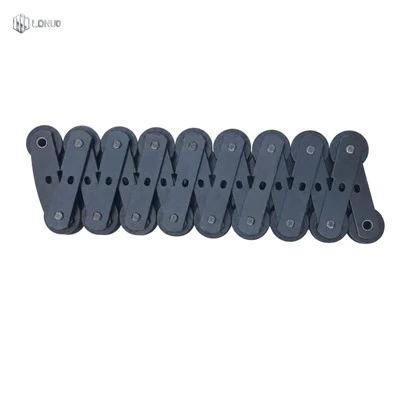
Escalator Travelator Pallet Chain If you’re a building owner, facility manager, or someone looking to install a new escalator, or if you have questions about the load capacity of your existing one, we’re here to help. We don’t just sell parts and install escalators—we work with you to make sure every step of the process, from design to maintenance, is safe and fits your needs. Whether you need to replace a few worn steps, upgrade an old escalator, or install a brand new system, our team can guide you through all the technical details, including weight limits, to keep your escalator running smoothly for years to come.
References
- ANSI A17.1: Safety Standard for Passenger Conveyors. American Society of Mechanical Engineers, 2022.
- EN 115-1: Safety of Escalators and Moving Walkways – Part 1: Escalators for Passengers. European Committee for Standardization, 2017.
- Escalator Step Design and Load Testing Manual. National Association of Elevator Contractors, 2021.
- “Dynamic Load Calculations for Passenger Conveyors.” Journal of Mechanical Engineering, Vol. 67, No. 4, 2020, pp. 215-222.
Huzhou Longnuo Electromechanical Co., Ltd.
As one of the most professional escalator manufacturers and suppliers in China, we also support custom service. We warmly welcome you to wholesale durable escalator made in China here from our factory. If you have any enquiry about cooperation, please feel free to email us.
Address: 2-2105, Jiayuan Center Square, Nanxun District, Huzhou City, Zhejiang Province, China
E-mail: zhenlei@hzlnjd.com
WebSite: https://www.lonuofuji.com/
