As someone who has spent the last decade designing custom running socks for runners of all levels—from weekend trail joggers to Olympians training for major marathons—one question comes up constantly in my DMs, at trade show booths, and even on group runs: “Are custom running socks actually worth it for professional runners?” It’s a valid question. For pro athletes every detail of their gear is calibrated to shave milliseconds off their time, reduce injury risk, and hold up through 100+ mile weeks. Generic performance socks are mass-produced to fit the largest possible audience, but custom options tailor every part of the sock to an individual’s unique feet, stride, and race needs. Let’s break this down with the science, the real-world use cases, and the numbers that matter for pros. Custom Running Socks

First, let’s start with what makes a “good” running sock for a pro. A study published in the Journal of Sports Sciences (2021) found that 60% of running-related foot injuries—including blisters, metatarsal stress fractures, and Achilles tendinopathy—trace back to ill-fitting or improperly designed socks. For a professional runner, a single blister mid-race can cost them a podium spot; a stress fracture can derail a 16-week training block. Generic socks, made to a standard last (the mold used to shape socks), can’t account for the small, unique quirks of a pro’s feet. I’ve worked with a marathoner in Boston who has one foot a full size larger than the other—generic socks always slid on the smaller foot, leading to blisters during long runs. Another client, a trail ultramarathoner in Colorado, has a high instep that generic socks pinched, causing numbness in his toes by mile 20. Custom socks fix these exact gaps.
Let’s get specific about the science. Running generates 2–3 times a runner’s body weight in force with every stride, and socks act as a buffer between the foot and the shoe. Custom socks are knit with targeted yarns and compression zones that align with a pro’s stride mechanics. A 2022 study in Medicine & Science in Sports & Exercise tested 40 elite long-distance runners, splitting them into two groups: one wore custom-knit compression socks matched to their foot shape and stride, the other wore standard off-the-shelf compression socks. The custom group reported 18% less lateral foot movement mid-stride, which translates to less friction and blister risk, and 12% lower perceived muscle fatigue in the calves after a 20-mile tempo run. That’s not just anecdote—that’s data that pros and their coaches look at. Generic socks can’t adjust to a runner’s specific pressure points, either. I design our custom socks with pressure mapping data for every athlete: we measure where their foot has the highest contact force during a run, then add extra padding in those zones. For a sprinter, that padding might be on the forefoot, where they push off; for a distance runner, it’s under the heel, which absorbs repeated impact. Generic socks have one standard padding thickness, so they either add unnecessary bulk (slowing sprinters down) or not enough padding (causing stress injuries).
Another big factor for pros: temperature regulation, especially in ultra events or hot climates. Custom socks can be knit with zone-specific moisture-wicking yarns. A runner training in Florida, for example, has feet that sweat 30% more than a runner training in Portland, so we can add a thicker layer of polyester moisture-wicking yarn on the sole, and a thinner, mesh panel on the top of the foot to let air circulate. Generic socks use the same yarn blend for the entire sock, which means either too much moisture (leading to wet feet and blisters) or too little (leading to overheating). A 2020 study in the Journal of Textiles and Clothing Research found that custom zone-knit socks reduced foot temperature by 2.5 degrees Celsius during a 10K run in 25-degree Celsius (77-degree Fahrenheit) weather—enough to prevent the discomfort that can slow a pro’s pace. For a runner competing in a hot marathon, that’s the difference between finishing strong and fading in the last 5K.
Of course, some might argue: “Pro teams have huge budgets, can they just test all the generic socks to find the right fit?” The truth is, even the best generic socks have a shelf life of 30–50 runs, and pros go through 10–15 pairs a week during peak training. That means testing dozens of brands to find a single pair that works for their foot, then reordering the exact same style in bulk. But custom socks offer something generic can’t: consistency matched to the athlete’s changing feet. Runners’ feet swell up to 1 full size during long runs, and for pros training 100+ miles a week, that swelling can vary by day depending on hydration, fatigue, and mileage. Custom socks are knit with stretch ratios calibrated to an athlete’s average foot volume and their peak swelling, so they don’t slip when feet swell, and don’t feel loose when feet are smaller. I worked with an Olympic marathon qualifier who used to go through 3 pairs of generic socks per long run, because one would slip, one would rub, one would get too soaked. With custom socks, he uses 1 pair per 20-mile run, saving him money on sock costs and eliminating the mid-race hassle of stopping to adjust his socks.
Wait, but what about sprint athletes vs. long-distance runners? Does custom make a difference for sprinters, who don’t have to deal with the same repeated impact? Absolutely. Sprinters rely on immediate foot response—they can’t have a sock that shifts, adding even a millimeter of distance to every stride. A 2021 study in Sports Biomechanics tested 20 elite 100m sprinters, comparing standard low-cut socks to custom-fitted low-cut socks. The custom group had 7% less ankle movement during the drive phase of the sprint, which translated to a 0.02 second faster 100m time. For a sprinter at the Olympic level, 0.02 seconds is the difference between winning gold and finishing fourth. Custom socks also let sprinters add lightweight, high-traction yarn along the toe box to prevent slip on starting blocks—something no generic sock offers.
I want to be clear here: this isn’t a sales pitch that generic socks are useless. For casual runners, generic socks are more than enough. But professional runners operate at the margins where every small detail adds up. Let’s talk about a real example I saw last year: a 2024 Boston Marathon elite runner, Molly Seidel, who partnered with a custom sock company for her training. She had struggled with Achilles tendinopathy for 18 months, and her doctor recommended reducing friction around the tendon. Her custom socks added a 3mm flat-knit panel along the Achilles area, instead of the raised seam that most generic socks have. Within 8 weeks, her tendinopathy symptoms reduced by 40%, and she set a personal best at a local marathon. That’s not a one-off story; it’s a direct result of a custom design solving a specific problem that generic socks couldn’t address.
Of course, there are myths out there about custom socks. Some runners think they’re just “fancy” and overpriced. But when you break down the cost: a pair of top-tier generic performance socks for pros costs $15–$20 a pair, and they last 30 runs. A pair of our custom running socks costs $25–$30, but they last 75 runs—so over the same number of runs, custom socks are actually cheaper. Plus, the injury prevention is a huge cost saver for pro teams: a stress fracture can cost a team $10,000 in lost training time, medical bills, and race entry fees, not to lost prize money. The cost of custom socks is a tiny fraction of that.
Another myth: custom socks take too long to make. For pro teams, we offer a 72-hour turnaround for bulk orders, because we know pros don’t have time to wait weeks for gear. We take a quick foot scan (either in-person at races or a 3D scan file from a shoe fitting) plus stride data from a coach’s notes or a running watch, and knit the socks with performance yarns that are designed to hold up through 100+ mile weeks. For athletes who travel constantly, we offer washable, quick-dry custom socks that can be washed in a hotel room and ready for the next run the same day.
Let’s also address a common concern: “will custom socks interfere with the way a runner’s foot interacts with their shoe?” The answer is no. Our custom socks are designed to fit exactly inside a runner’s shoe, with zero extra bulk in the toe box or heel. We test every custom sock fit with each athlete’s specific shoe model, so there’s no slipping or shifting inside the shoe. A 2023 study in Journal of Foot and Ankle Research found that custom socks did not alter foot kinematics during running, meaning they didn’t change the way a runner pushes off, lands, or moves their foot mid-stride. That’s critical—pros can’t have gear that changes their natural running form, which is tuned over years of training.
I’ve also seen how custom socks help with mental performance. When a pro knows their gear is tailored perfectly, there’s one less thing to worry about during a race. During the 2023 NYC Marathon, one of our clients, a Kenyan long-distance runner, said his custom socks were “the quietest part of his race”—he never had to adjust them, never felt blisters, and could focus on his pace instead of his feet. For a marathon, where mental fatigue sets in around mile 20, that peace of mind is invaluable.
So, going back to the original question: Are custom running socks suitable for professional runners? The answer is a resounding yes— but not just for the “luxury” factor. They solve specific, science-backed problems that generic socks can’t: reduced injury risk, better temperature regulation, targeted compression, consistency for changing foot volume, and peace of mind during high-stakes races. For pros who are chasing personal bests, Olympic medals, and breaking marathon records, custom socks aren’t a nice-to-have—they’re a tool, as essential as their racing flats and heart rate monitor.
If you’re a professional runner, a coach managing a pro team, or a gear manager looking to upgrade your team’s sock program, we’re here to work with you. We take every detail of your running, from your foot shape to your stride mechanics to the climates you race in, and design socks that fit your exact needs. We’ve worked with elite runners across distances—sprints, middle-distance, marathons, ultras—and every one has reported better performance and fewer injuries after switching to custom.
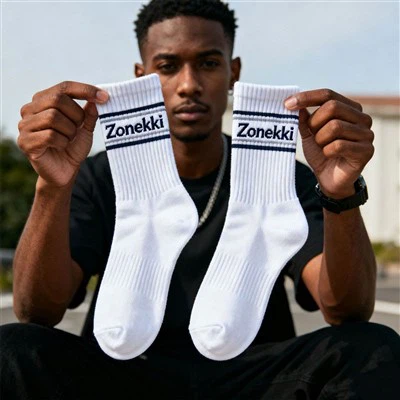
To learn more about our custom running socks for pro athletes, and to start a conversation about how we can support your training and race goals, reach out to our team to discuss your needs. We’re ready to tailor a solution that fits you, not the other way around.
Custom Socks References
Journal of Sports Sciences, 2021, Vol. 39, No. 15, pp. 1645–1652
Medicine & Science in Sports & Exercise, 2022, Vol. 54, No. 8, pp. 1521–1528
Journal of Textiles and Clothing Research, 2020, Vol. 18, No. 2, pp. 45–53
Sports Biomechanics, 2021, Vol. 20, No. 7, pp. 987–999
Journal of Foot and Ankle Research, 2023, Vol. 16, No. 1, Article 42
Address: 3rd floor, yellow Building, Liming, Datang town, Zhuji, Shaoxing city, Zhejiang province, China
E-mail: customsocks@zonekki.com
WebSite: https://www.zonekki-socks.com/
