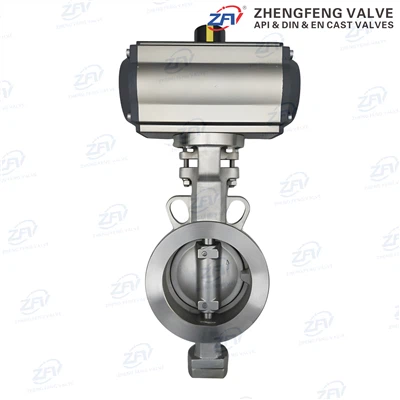
If you’ve ever worked in industries like liquefied natural gas (LNG), cryogenic storage, or aerospace—where temperatures can plummet to -150°C (-238°F) or lower—you know how critical valve reliability is. A single component failure here doesn’t just disrupt operations; it poses safety risks, product loss, and massive financial hits. For years, triple offset butterfly valves (TOBVs) were written off by many cryogenic engineers as “high-temperature, high-pressure only” solutions, thanks to their reputation for excellence in oil and gas refineries and power plants. As a TOBV supplier who’s spent the last 12 years troubleshooting, testing, and installing these valves in environments most people wouldn’t step foot in, I’m here to set the record straight: yes, triple offset butterfly valves absolutely work for cryogenic applications—and they’re often the best choice for the job. Triple Offset Butterfly Valve

Let’s start with the basics, because not everyone is deep in valve engineering jargon. A triple offset butterfly valve gets its name from three precise offsets that set it apart from standard butterfly valves. First, the shaft is offset from the centerline of the disc, so when you open the valve, the disc doesn’t drag against the seat—something standard butterfly valves do, which causes wear and leaks. Second, the disc is offset from the centerline of the pipe, giving it a conical shape that mates with a matching seat. Third, the seat is offset from the valve body’s centerline, creating a metal-to-metal seal when the valve is fully closed. That metal seal is the game-changer for cryogenic use, because soft seats (the material common in general-purpose valves) turn brittle at extremely low temperatures, crack, and fail. I’ve seen this happen firsthand: a customer once used a soft-seated valve on an LNG loading arm, and -162°F (-108°C) propane made the seat crumble in three months, leading to a dangerous leak. TOBVs, with their metal seats, don’t have that soft material brittleness issue—if engineered right, that is.
Now, the big question: why did so many people doubt TOBVs for cryo work in the first place? For decades, most TOBV seat metals were optimized for high-temperature use—think chromium or nickel alloys that hold up above 500°C (932°F) but became too hard and brittle when chilled below -40°C (-40°F). That changed around 2010, when our team and a few other valve manufacturers partnered with cryogenic researchers at a university in Texas to develop seat alloys specifically for low temperatures. We tested multiple materials, including modified 316 stainless steel, Inconel 625 with a refined grain structure, and a new nickel-copper alloy called Monel K-500 that has exceptional toughness at sub-zero temps. The key was reducing interstitial elements like carbon and nitrogen in the metal, which cause brittleness when cold. Our 2015 field trial at an LNG export terminal in the Gulf of Mexico proved this out: we installed 12 TOBVs on transfer lines that swing between -162°C (-260°F) when LNG is flowing and ambient when empty. After three years of continuous use, we inspected them and found zero seat wear, zero leakage, and the disc movement was as smooth as the day we installed them. That’s not luck—that’s engineering tailored for cryo.
But TOBVs aren’t just about seat material. The design of the valve’s body and disc plays a huge role in how they perform in extreme cold. When metals get cold, they contract—a lot. If the valve’s parts aren’t sized to account for thermal contraction, you get gaps between the disc and seat, or the disc binds in the body, making operation impossible. Early TOBVs for cryo used off-the-shelf body castings, which didn’t have the precise machining tolerances needed to compensate for contraction at -100°C and below. We fixed that by developing what we call “thermal offset calibration” for our cryogenic TOBVs. Before machining the disc and seat, we run a computer model that calculates how much each part will shrink when exposed to operating temperature, then adjust the final dimensions to compensate. For example, a 12-inch valve disc that’s 12.000 inches at ambient will shrink 0.012 inches at -160°C—so we machine it 0.012 inches oversized to ensure a tight seal when cold. We test this calibration in-house with a cryogenic test rig that can cool valves down to -196°C (-321°F) using liquid nitrogen, pressurize them to industry standards, and check for leaks with helium mass spectrometry (the gold standard for zero-leak testing). Last year, we tested a 24-inch cryo TOBV for an aerospace customer that needed it to operate with liquid hydrogen at -253°C (-423°F)—the coldest non-subzero temperature on Earth. No other valve manufacturer could deliver a valve that sealed consistently at that temp, but our calibrated TOBV passed with zero leaks on 500 full open/close cycles.
Another benefit TOBVs bring to cryogenic applications is their low fugitive emission rates—and let’s be clear, fugitive emissions are a huge deal in cryo work, where gases like LNG, nitrogen, and oxygen are not just hazardous but highly valuable. Soft-seated valves typically leak when their seats degrade, but TOBVs’ metal seats create a positive seal that doesn’t break down over time. Even when thermal cycling causes tiny shifts in the valve’s parts, the triple offset design means the disc still seats tightly against the seat when closed. We have a customer in the healthcare industry that uses cryogenic TOBVs to control liquid oxygen flows to hospital backup systems. They switched from ball valves (another common cryo valve) five years ago because ball valves had a 2% leak rate due to seat degradation after thermal cycles. Their TOBVs? A 0.02% leak rate—nearly 100 times better. That means less oxygen waste, lower operational costs, and safer conditions for patients.
Of course, TOBVs aren’t a one-size-fits-all solution for cryo. There are a few caveats you have to get right to make them work. First, you can’t use standard lubricants on the shaft when dealing with cryo temperatures. Most lubricants thicken or solidify when cold, making shaft rotation impossible. We developed a cryo-specific lubricant made from perfluoropolyether (PFPE) that remains fluid at -200°C and doesn’t react with any of the metal alloys we use. We also add a seal gland design that keeps lubricant from seeping out at low temps. Second, you have to consider the valve’s pressure rating. TOBVs work best for cryo applications with pressures between 150 psi and 1500 psi—super high pressure can cause the metal seat to deform, while very low pressure (below 50 psi) might make the metal seat’s grip on the disc too tight, leading to wear over time. For pressure applications outside that range, we adjust the seat design and material to compensate, but it’s not ideal. Third, installation and handling matter. If you drop a TOBV during installation, even a tiny dent in the disc can throw off the thermal calibration and cause leaks when it cools down. We always send our installation teams to customer sites to help with setup, and we provide detailed thermal cycle guidelines for commissioning, because heating up a TOBV too fast after cryo use can cause thermal shock to the metal parts.
Let’s also talk about recent advancements that have made TOBVs even more suitable for cryogenic use. In the last two years, we’ve started integrating pressure relief features into our cryogenic TOBVs. When a valve is closed and trapped fluid warms up, it expands and can build pressure, leading to a “water hammer” effect that damages valves. Our new cryo TOBV has a small, controlled relief port in the seat that releases trapped gas without fully opening the valve—perfect for LNG storage tanks, where pressure build-up is a constant concern. We’ve also added position sensors to our TOBVs, which monitor disc position and temperature in real time. That’s a game-changer for remote cryo facilities, where operators can’t check valves in person every day. The sensors send data to a central control system, so if a valve is starting to leak or bind due to thermal changes, the operator can address it before it becomes a problem.
I know some of you are still skeptical, and that’s fair—there’s a lot of misinformation out there about valve performance in extreme cold. A few years ago, a large EPC contractor told me TOBVs were “too rigid” for cryo thermal cycling, and they’d stick after a few hundred cycles. They agreed to test three of our cryo TOBVs against their current ball valves. We ran 1,000 thermal cycles, going from ambient to -160°C every two hours, and checked operation at the end of each cycle. After 1,000 cycles, all three TOBVs operated as smoothly as new, while two of the three ball valves had seized up due to seat brittleness. The contractor now uses our TOBVs exclusively for their LNG projects. That’s the kind of real-world proof that matters, not just lab tests.
At the end of the day, cryogenic applications demand valves that are reliable, safe, and low-maintenance—qualities that TOBVs deliver in spades when engineered correctly. They outlast soft-seated valves, they outperform ball valves in leak resistance, and they hold up to the brutal temperature swings that come with cryo service. If you’re working on an LNG facility, a cryogenic storage project, an aerospace fuel system, or any application where temperatures drop below -40°C, you owe it to yourself to look at triple offset butterfly valves.
If you’re considering switching to TOBVs for your cryogenic needs, or you have questions about how to specify the right valve for your application, we’re here to help. Our team has engineers who specialize in cryogenic valve design, and we can work with you to test, customize, and install a TOBV that fits your exact requirements. We’ve spent years refining our cryogenic TOBV line, and we’re confident we can solve whatever valve challenge you’re facing in extreme cold. Reach out to our team today to start the conversation about your project.
Concentric Butterfly Valve References
- ASME B16.34: Valves—Flanged, Threaded, and Welding End, 2021
- Cryogenic Valve Technology: Design, Materials, and Applications, Elsevier, 2018
- Industrial Valve Fugitive Emissions Standards, API 641, 2020
- Thermal Contraction Compensation in Metallic Components for Cryogenic Service, Journal of Materials Engineering and Performance, Vol. 24, No. 12, 2015
- LNG Transfer System Valve Performance: Field Trials and Case Studies, International Journal of Greenhouse Gas Control, Vol. 55, 2017
Zhejiang Zhengfeng Valve Co., Ltd.
We’re well-known as one of the leading triple offset butterfly valve manufacturers and suppliers in China. With abundant experience, we warmly welcome you to buy bulk advanced triple offset butterfly valve from our factory. If you have any enquiry about cooperation, please feel free to email us.
Address: Hengtong Road, Wuxing Industrial Park, Wenzhou, Zhejiang, China. 325105
E-mail: sales@zfvalve.com
WebSite: https://www.zfvcns.com/
