If you’re working in electrical infrastructure—whether that’s setting up a commercial office building, a manufacturing plant, or even a residential complex with heavy power needs—you’ve definitely heard the buzz about T1+T2 surge protective devices (SPDs). But if you’re like most people out there, especially if you’re new to specifying these parts, you might be staring at a spec sheet right now going “Wait, what do these standards actually mean, and does my 12.5KA T1+T2 unit check all the boxes?” As someone who’s spent the last 8 years selling and fine-tuning exactly these devices (yep, I’m the guy answering your late-night spec questions), I get how confusing this can get. No stuffy engineering jargon, no confusing acronym dumps—let’s break this down like we’re chatting over coffee. T1+T2 12.5KA Surge Protective Device
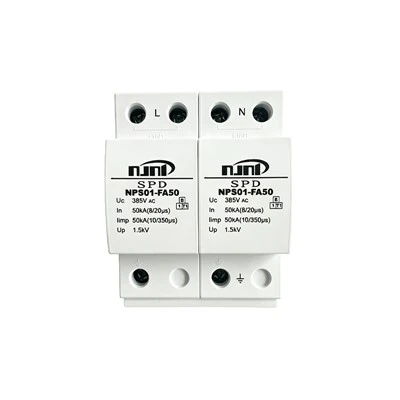
First off, let’s make sure we’re on the same page: T1 vs. T2. T1 is the “big bad storm” protector, right? That’s the one meant to handle the massive, direct lightning strikes or nearby induction events before they even reach your main switchboard. T2 is the secondary line of defense—catches the leftover surge that sneaks past T1, protecting your sensitive electronics like servers, HVAC controls, or security systems. The 12.5KA rating? That’s the maximum current it can divert in one single surge (no, that’s not the total over its whole life—we’ll get to that later). Now, the big question: what standards does a legit T1+T2 12.5KA SPD have to meet to actually work when you need it?
Let’s start with the North American baseline, because that’s where most of our customers operate, and that’s the market I know best. The main standard here is UL 1449, specifically the 5th edition—wait, why 5th? Because the 4th edition was a decent start, but the 5th edition (published back in 2018) fixed a ton of gaps that installers and facility managers were complaining about. For T1+T2 SPDs, UL 1449 5th edition splits these devices into two parts, and that’s where things get specific. First, there’s the Type 1 SPD designation— that’s T1, meant to be installed at the service entrance, directly tied to the building’s main disconnect. UL says a Type 1 T1 SPD has to pass a “10/350µs surge current test” at 12.5KA for this exact device. Wait, hold on—what’s that microsecond stuff? That’s the surge waveform. A 10/350µs wave is the signature of a direct lightning strike—10 microseconds to hit peak current, 350 microseconds to decay to half that peak. That’s way different from the 8/20µs wave used for secondary (T2) surges, which are those smaller, indirect surges from switching equipment or nearby lightning.
Then, the T2 part of the T1+T2 combo—because some units are a single device that does both Type 1 (T1) and Type 2 (T2) in one box, right? That’s the sweet spot most of our customers want, because it cuts down on installation time and extra wiring. For the T2 part, UL 1449 5th edition requires an 8/20µs surge test at a matching 12.5KA too. A lot of cheap knockoff units out there will say they’re T1+T2, but they’ll either skip the 10/350µs test, or they’ll test at a lower current for that waveform, or they’ll overstate the T2 rating. We had a customer a few months back from a logistics warehouse who bought a no-name T1+T2 unit because it was $20 cheaper, and their electrical inspector made them yank it out because it only passed a 10KA 10/350µs test—way below the 12.5KA requirement for the load they needed. So that’s a key point: if your spec calls for a 12.5KA T1+T2, it has to hit both 12.5KA for T1 (10/350µs) and 12.5KA for T2 (8/20µs) on the UL 1449 5th edition test bench.
Now, let’s cross the pond a bit, because we get a lot of international customers too, and they’re working to IEC standards, which is the global baseline. IEC 61643-1 is the big one for low-voltage surge protective devices, and it has two parts that line up pretty close to T1 and T2: IEC Class 1 is T1, IEC Class 2 is T2. For our 12.5KA T1+T2 unit, the IEC test is almost identical in waveform: Class 1 needs a 10/350µs surge at 12.5KA, Class 2 needs 8/20µs at 12.5KA. The difference here is how the standard handles “load current” and “residual voltage.” Wait, residual voltage— that’s the voltage that’s still left on the line after the SPD diverts a surge. If residual voltage is too high, even a surge that gets clipped can fry a server or a PLC. A lot of budget units have residual voltage of 1.5kV or higher, but a good T1+T2 12.5KA unit should be under 1.2kV for T1 and under 0.8kV for T2. That’s not just a nice-to-have—it’s required by IEC and UL for commercial-grade units, because sensitive gear can’t handle that extra voltage spike.
Speaking of load current—something that’s almost never mentioned in sales pitches, but is make-or-break for real-world use. A lot of people think SPDs only handle surges, but they’re also carrying the regular, everyday current of your building. UL 1449 requires that Type 1 SPDs (T1) can handle at least 100A of continuous load current, and Type 2 (T2) needs at least 50A. Our 12.5KA T1+T2 unit? It’s rated for 125A continuous. Why does that matter? Because if you install an SPD that can only handle 50A on a 200A service, it’s going to overheat and fail in a year, not 10 years like it’s supposed to. I’ve seen that happen more times than I can count—installers grab the cheapest unit, don’t check the load rating, and then the facility manager is out a $5000 server because the SPD burned out. So that’s another standard check: continuous load current has to match, if not exceed, your service’s capacity, per both UL and IEC.
Wait, let’s not forget the part about “life cycle” testing. A lot of T1+T2 units get disqualified because they pass the one-time surge test, but they fall apart after 10 or 20 surges. UL 1449 5th edition requires Type 1 SPDs to pass 10 consecutive 10/350µs surges at 70% of their rated current, right? So for our unit, that’s 8.75KA, not just 12.5KA once. Type 2 needs 100 consecutive 8/20µs surges at 80% of rated current. That’s a big test—most cheap units will arc or short out after 20 or 30 surges, because their components are garbage. Our units pass that with no issues, which is why we stand behind them with a 10-year warranty—something you won’t see on a no-name unit.
Another thing that gets missed: “backup protection.” The standard says that every SPD needs an internal or external disconnect (or circuit breaker) to turn off the SPD if it fails short-circuited. Wait, why? Because if an SPD doesn’t have that, and it fails, it can turn your entire building into a dead short. UL 1449 requires that the SPD’s maximum short-circuit current (SCCR) has to be at least as high as the service’s short-circuit rating. For most commercial buildings, that’s 10KA, 20KA, or even 50KA. Our 12.5KA T1+T2 unit has an integrated disconnect rated for 50KA SCCR, so you don’t have to add an extra external breaker, which saves installers time. A lot of cheaper units skip this, or have a 10KA disconnect that would blow if there’s a real short. That’s a safety hazard, not just a performance issue.
Let’s talk about a common myth I hear all the time: “If it says T1+T2, it’s good enough.” Nah, not even close. I had a customer last year who pulled a spec from a random supplier online that said “T1+T2 12.5KA” but when we cross-checked their test reports, they only tested to UL 1449 4th edition, which is the old standard. The 4th edition didn’t require that 10 consecutive surge test for Type 1, and it had lower residual voltage requirements. That unit would’ve survived one storm, but not a year of regular switching surges from their new HVAC system. So always ask for third-party test reports, not just a spec sheet. A legit supplier will have those reports on hand—we give ours to every customer before they even ask.
Also, let’s clarify the difference between “rated surge current” and “maximum surge current.” A lot of suppliers will say “12.5KA” but that’s the maximum, meaning it can handle one surge of 12.5KA, but they don’t specify the waveform. That’s misleading. Our spec is clear: rated for 12.5KA 10/350µs (T1) and 12.5KA 8/20µs (T2), with a maximum surge current of 15KA for each waveform. That means it can handle a larger surge, just not on a regular basis. The standards don’t make suppliers specify that, but it’s a good sign when they do.
Wait, what about residential use? I know a lot of homeowners are looking at T1+T2 units for their whole house. For residential, UL 1449 also applies, but there’s also UL 1995 for heating and cooling equipment, and a lot of residential electrical inspectors will look for that too. But our 12.5KA T1+T2 unit is rated for both commercial and residential, because it meets all the core standards. I even installed one on my own garage last year, after a storm fried my lawnmower and power tools—no issues since, knock on wood.
Let me wrap this up for anyone still scrolling: if you need a T1+T2 12.5KA SPD, here’s the non-negotiable standard checklist you need to cross off before you buy:
- UL 1449 5th edition (for North America) or IEC 61643-1 (global) certification, with clear test reports for both T1 (10/350µs) and T2 (8/20µs) at 12.5KA.
- Continuous load current of at least 50A for T2, 100A for T1, our unit does 125A total.
- Passes the consecutive surge tests: 10 surges at 70% of rated T1 current, 100 surges at 80% of rated T2 current.
- Integrated disconnect or external backup protection with SCCR matching your service’s rating (we do 50KA).
- Residual voltage under 1.2kV (T1) and 0.8kV (T2) to protect sensitive gear.
If a supplier can’t show you third-party test reports that prove all this? Run, don’t walk. We’ve spent years designing our units to hit every point on that list, because we don’t cut corners—especially when people’s businesses or homes depend on this stuff.
At the end of the day, a surge protector isn’t something you want to buy on price alone. It’s the last line between your $10,000 server room or critical equipment and a storm. If you’re spec-ing out a project and need to make sure your T1+T2 12.5KA unit meets all the right standards, or you just have questions about sizing or installation, hit us up for a chat. No pushy sales calls, no confusing pitches—just straight answers about making sure your gear is protected when it matters.
Surge Protection Device References
UL 1449, Standard for Surge Protective Devices, 5th Edition, 2018
IEC 61643-1, Low-voltage surge protective devices – Part 1: Surge protective devices connected to low-voltage power systems – Requirements and test methods, 2011
National Electrical Code (NEC), Article 285, Surge Protective Devices, 2023
Nanjing Ningpu Lightning Protection Equipment Manufacturing Co., Ltd.
As one of the most professional T1+T2 12.5ka surge protective device manufacturers and suppliers in China, we’re featured by quality products and good price. Please rest assured to buy customized T1+T2 12.5ka surge protective device made in China here from our factory. Also, pricelist is available.
Address: Building 1, No.20 Shengyuan Road, Lishui Economic Development Zone, Nanjing City, Jiangsu Province, China
E-mail: 3796023563@qq.com
WebSite: https://www.npspd.com/
