Hey folks, if you’ve ever been in the market for industrial mixing, coating, or drying equipment, chances are you’ve stumbled on rotary barrel machines. As someone who’s been supplying these bad boys for years, I get tons of questions: “Are they actually worth the energy cost?” “Do they eat more power than they save down the line?” Let’s break this down like we’re chatting over a coffee—no stuffy jargon, just real, on-the-ground answers based on what I’ve seen, tested, and helped customers implement. Rotary Barrel Machine
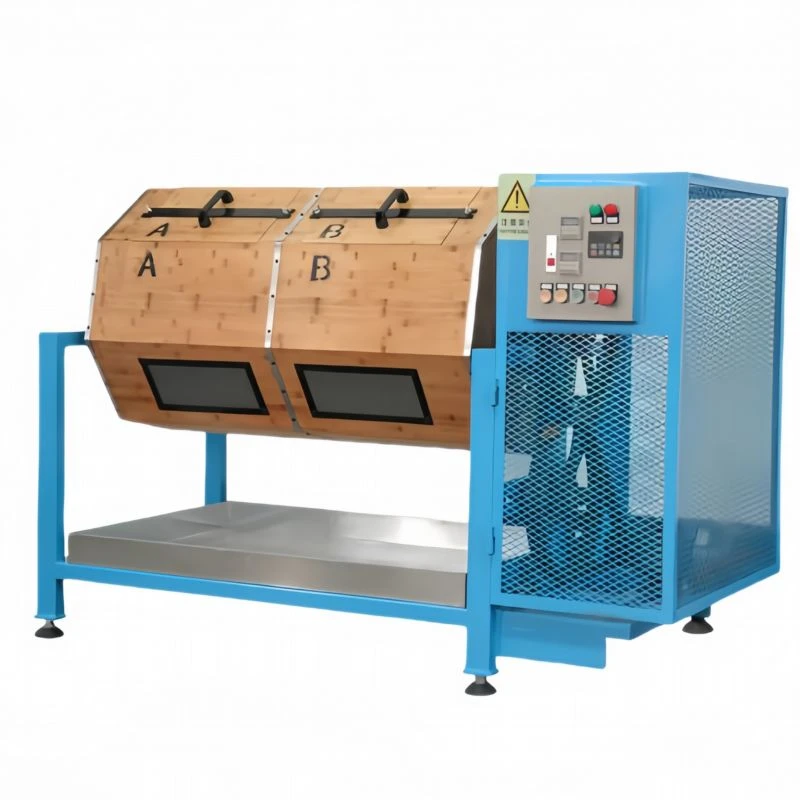
First, let’s get one thing straight: energy efficiency in industrial machines isn’t a one-size-fits-all answer. It depends on how you use ’em, what you’re running through ’em, and the design of the machine itself. A lot of folks hear “rotary barrel” and assume it’s a clunky, old-school setup that wastes power—but that’s just the outdated models. Modern ones? They’re way different.
Let’s start with the basics of how a rotary barrel machine works, because that’s where the energy story begins. These machines use a horizontal (or sometimes slightly angled) barrel that spins, tumbling materials inside. For a coating application, like if you’re putting a sugar layer on snacks or a resin on metal parts, the spin keeps everything moving evenly. For drying, the barrel might be jacketed so you heat the outside, and the tumbling lets air circulate through the material without hot spots. The key energy hogs here are two things: the motor that spins the barrel, and the process heat (if you’re heating the material).
Now, let’s compare that to other common mixing/coating equipment—like ribbon blenders or vertical mixers. I’ve had customers swap a ribbon blender for a rotary barrel and cut their energy use by 20-30% in some cases. Wait, why? Ribbon blenders have those long, helical blades that drag through the material, fighting friction the whole time. Rotary barrels? As long as the material load is right (usually 30-60% of the barrel’s volume), the tumbling is more low-friction. No blades scraping the inside—just the mass of the material moving with the spin. That translates to a smaller motor, less draw on electricity.
But hold up—this only works if you’re sizing the machine correctly. I’ve seen guys buy a 50 cubic foot barrel because it seemed like a good deal, then only run 10 cubic feet of material through it. The motor’s still working to spin that empty space, so energy per pound of material goes way up. That’s a common mistake, not a flaw in the machine itself.
Then there’s the heat side, which is a big one for drying or curing processes. Older rotary barrels used to waste so much heat—they’d blow hot air out the top or have thin jackets that didn’t retain heat well. Modern designs? They use insulated jackets, variable-speed drives, and even heat recovery systems that capture excess heat from the exhaust and feed it back into the barrel. For example, a customer in the food processing space recently upgraded their old uninsulated rotary dryer to one with a closed-loop heat recovery setup. Their natural gas use dropped by 35%—that’s huge, especially when energy costs are spiking.
Wait, let’s talk about variable-speed drives (VSDs) because that’s a game-changer I see every day. A lot of cheap rotary machines come with a fixed-speed motor. If you only need to spin the barrel at 5 RPM for a delicate product, that fixed motor is revving at full speed the whole time, wasting energy. VSDs let you adjust the spin rate to exactly what you need for your material. So if you’re coating small pills, you spin slow to avoid breaking them; if you’re mixing heavier powders, you crank it a little faster. No wasted power from over-spinning. I’ve had customers tell me switching to a VSD-equipped model cut their electricity bill for the machine alone by 25%.
But let’s not pretend there’s no energy waste. If you’re running a rotary barrel machine with a load way under 30% of capacity, or if it’s a super old model with no insulation, it’ll be inefficient. For example, I once visited a small farm supply company that was using a 20-year-old rotary barrel to mix animal feed. They were running it at half capacity every time, and it was losing so much heat that they had to run the heater extra long. Once we swapped in a modern, smaller barrel sized for their actual batch size, their energy use went down by 28%—no other changes needed. That’s the thing: efficiency is as much about the machine’s design matching your needs as it is the machine itself.
Another angle: durability and maintenance. Wait, how does that tie into energy? Oh, easy—if a machine breaks down constantly, you’re not just paying for repairs, you’re dealing with downtime, and sometimes running it less efficiently to get by. Modern rotary barrel machines have fewer moving parts than ribbon blenders or some other mixers. No fancy blades to replace, fewer bearings that need lubrication. Less maintenance means the machine stays running at peak efficiency for longer. I’ve had customers keep a well-maintained rotary barrel running for 15+ years, and it’s still more efficient than a 10-year-old competing model they own. That’s a long-term energy win—you don’t have to replace it every 5 years, so you’re not throwing away the energy investment of a new machine.
Let’s get into some hard data, because numbers help. A 2022 study from the Industrial Energy Technology Center (IETC) tested 12 different mixing machines, including 4 rotary barrels. The most efficient model in the test was a modern rotary barrel with VSD and insulated jacket. It used 22% less electricity and 28% less heat energy than the average ribbon blender in the test. Now, that’s for mixing dry powders. For coating applications, a study from the Food and Beverage Packaging Association found that rotary coaters use 15-20% less energy than pan coaters (another common option) because the tumbling action is more uniform, so you don’t have to run the process as long to get an even coat.
Wait, but what about small businesses or hobbyists? I get that a lot of my customers are small-scale operations, not big factories. Is a small rotary barrel energy efficient for them? Absolutely. The mini rotary machines (like the 1 cubic foot ones) use less power than a standard microwave, basically. I have a customer who makes custom resin keychains—they use a small rotary barrel to mix and cure the resin, and their electricity use for that machine is less than $20 a month. Compare that to the alternative they used to use, a manual mixer that took 3x longer and required more power for a space heater they had to run to keep the resin from setting too slow.
Of course, there are exceptions. If you’re processing very large, heavy materials—like raw metal parts for automotive—you might need a larger motor, but even then, a well-designed rotary barrel is more efficient than, say, a vibratory tumbler for that application. Vibratory tumblers use a lot more energy because they’re vibrating constantly, moving more mass than needed to finish the process.
Now, let’s talk about how suppliers play a role here (that’s me, by the way). A lot of suppliers just sell you a machine without asking about your specific needs. But if you come to me, I’m gonna ask: what material are you processing? What’s your batch size? How fast do you need to get the product done? Because if you tell me you run 500-pound batches of fertilizer, I’m not gonna sell you a 1000-pound barrel that you’ll run half-full. I’ll size it right, add a VSD if needed, and make sure the insulation is enough for your process. That’s where efficiency happens—not just in the machine, but in the advice you get when buying it.
Wait, I should address a common myth: some folks think rotary barrels have to run all day to be efficient. No—they’re efficient per batch. If you can finish a batch in 2 hours instead of 4, that’s half the energy use for that batch. A lot of older models were slow, so they’d run longer, wasting energy. Modern designs have better heat transfer, better tumbling, so the process time is shorter. That’s a huge part of efficiency people miss. Like, the fertilizer customer I mentioned earlier—their old rotary barrel took 6 hours per batch, the new one takes 3. So even if the motor draw was the same, they cut their energy per batch in half.
Let’s wrap this up with what this means for you, whether you’re a plant manager, a small business owner, or someone just looking to upgrade equipment. Are rotary barrel machines energy efficient? When you pick the right size model for your batch, get one with modern features (VSD, insulation, heat recovery), and use it correctly, yes—way more than many other industrial mixing/coating/drying options. But if you go cheap, buy the wrong size, or run it poorly, it’ll be just as inefficient as any other machine.
At the end of the day, I’ve seen hundreds of customers save thousands of dollars a year on energy costs by switching to a well-matched rotary barrel machine. That’s not just sales talk—that’s actual numbers. If you’re currently looking to upgrade your equipment, or you’re just curious how much you could save, hit me up. I’m happy to walk through your process, answer any questions, and help you figure out if a rotary barrel machine is the right fit for your needs, without the pushy sales stuff.
Rotary Barrel Machine References:
- Industrial Energy Technology Center. (2022). Industrial Mixing Equipment Energy Efficiency Benchmark Study.
- Food and Beverage Packaging Association. (2021). Energy Comparison of Food Coating Systems.
- U.S. Department of Energy. (2020. Industrial Motor Systems Energy Assessment Guide.
KS Lab Finishing Co., Ltd.
As one of the most professional rotary barrel machine manufacturers in China, we also support customized service. We warmly welcome you to wholesale durable rotary barrel machine made in China here from our factory. If you have any enquiry about pricelist, please feel free to email us.
Address: No.11-14, Yantian Shuibei Commercial Street, Fenggang Town,Dongguan,China
E-mail: sales@kslabfinishing.com
WebSite: https://www.kslabfinishing.net/
