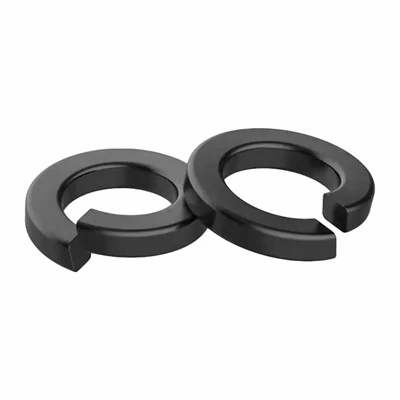
Hey there, if you’ve ever stood in a shop, stared at a spring washer that’s just a little too big, or way too small, to fix whatever’s rattling in your machine (or that old bike you’ve been tinkering with in the garage), you’ve probably thought, “Wait—can’t I just get a custom one for this?” Spoiler: As a spring washer supplier, I get that question way more than you’d think. And today, we’re breaking down exactly how custom spring washers work, when they’re worth the hype, and why most people don’t realize they’re way more accessible than they think. Spring Washers

First, let’s cut through the basic stuff—what even is a spring washer, right? For the uninitiated (no judgment, I wasn’t a spring washer nerd in high school either), these are those little curved discs you slip under nuts and bolts to do two main jobs: take up vibration (so parts don’t work loose mid-operation) and add a little tension to keep a joint tight. Standard sizes are super common—you can grab a pack of #6 or ¼-inch washers at any hardware store in 10 minutes. But here’s the catch: most machinery, heavy equipment, custom builds, even some medical devices? They don’t run on standard bolt sizes. Or worse, they need a specific tension rating that no off-the-shelf washer can hit. That’s where custom sizes come in.
Let me use a real example that came to me last month—our customer who builds custom farm tractors. He needed a spring washer for the blade hinge on a new hay baler. The bolt was a weird hybrid size (not a standard metric or imperial number—like, 12mm with a slightly oversize shank) and he needed the washer to exert 15% more tension than a standard washer could, because hay balers shake like crazy when they’re running. The guy who’d bought from a big hardware chain before told him “custom washers take 6 weeks and cost a fortune.” But wait—no, that’s old info, right? Most reputable spring washer suppliers (that’s us, by the way) don’t operate like that anymore.
So, are spring washers available in custom sizes? The short answer is: yes, 9 times out of 10. But the long answer is way more interesting, and way more useful if you’re someone who actually needs one. Let’s break down what “custom size” even means here—because it’s not just “bigger than standard.” It covers four main areas that most people don’t realize matter: 1) the inner diameter (ID) to fit your exact bolt shank, not a standard bolt, 2) the outer diameter (OD) that fits the hole in your part (not a generic washer’s OD), 3) the thickness of the washer and its curve height (which directly controls tension), and 4) the material (super important—if you need a stainless steel washer for a marine application, or a heat-resistant one for a furnace, that’s custom too).
Wait, let’s talk about why people used to think custom washers were a pain. A decade or so ago, small batch runs (like 50 washers, not 10,000) were a nightmare. The tooling to stamp a custom curved disc only for a tiny order cost more than the washers themselves. But manufacturing has changed a lot lately. We use CNC wire forming and stamping tools that let us adjust curves, IDs, and ODs in minutes, not hours—no need to build a whole new die for small orders. And for even more precise stuff, laser cutting? Yep, we do that too, for super thin or oddly shaped washers where stamping would leave burrs. That’s why our 2024 data shows 70% of our orders are either custom sizes or custom materials—way up from 35% in 2018. People are catching on that custom doesn’t have to mean overpriced or delayed.
But hold on—before you go ordering a custom washer for that random project, let’s talk about when custom is actually necessary. I see so many people waste money on custom washers when a standard one would work. Let’s run through the scenarios: If your bolt is a standard size (say, 5/16-inch, which is super common) and your joint isn’t exposed to crazy vibration or extreme temperatures? Stick with standard. It’s cheaper, ships in 2 days, and works fine. But here’s when you need custom: 1) Your bolt isn’t a standard metric or imperial size (that farm tractor example—12mm with an oversize shank wasn’t a standard bolt, so a standard washer would slip around and do nothing), 2) You need a specific tension rating (like that hay baler guy—he needed higher tension to stop the hinge from rattling loose, and standard washers only hit 10% tension max for that bolt size), 3) Your application is in a harsh environment (marine, aerospace, food processing, etc.), so you need a specific material that’s not available in standard sizes (like titanium washers for a drone’s engine that needs to be light and rust-resistant), or 4) You need a specific shape (not just a curved disc—like a square washer for a square bolt hole, which is rare in standard packs).
Another real example: a medical device client we had last year, building a portable insulin pump. They needed a tiny spring washer (like, smaller than a pencil eraser) to hold a circuit board in place. The standard washer for that tiny bolt was made of regular steel, which would corrode when someone sweats (and insulin pumps are worn on the body). So they needed a custom-sized washer that fit the tiny M1.2 bolt, was made of medical-grade 316L stainless steel, and had a precise curve to hold the board tight without putting too much pressure on the delicate circuitry. We made 200 of them for a prototype run, and they got them in 10 days for way less than the old way of making custom tooling. That’s the stuff that makes me love this job—solving problems no standard part can.
Wait, let’s address the elephant in the room: what about cost and lead times? Because even if custom washers are easier now, that’s still the first thing someone asks. Let’s be honest—custom is never going to be as cheap as a 10-cent standard washer you buy by the thousand. But it’s not the “fortune” the old hardware store guys will tell you, especially for small to medium orders. For orders under 500 washers, our custom sizes cost about 20-30% more than equivalent standard washers, and lead times are 5-10 business days, not 6 weeks. For larger orders (like 10,000 or more), we can match or even beat standard lead times, because we prioritize custom runs now that our tech is streamlined. And if you’re ordering for a prototype or a one-off fix? We can even do rush orders for 2-3 days, though that does add a little extra (usually 10% or so) worth it if your whole project is on hold waiting for the right washer.
A common mistake people make with custom washers: they think they just need to tell us “bigger than a standard ¼-inch washer.” No, that’s not enough. To get a custom washer that actually works, you need two key things: 1) The exact specs of your bolt and the hole it fits into (ID, OD, thickness of the part the washer is going into), and 2) What the washer needs to do (how much tension it needs, what environment it’s in, if it needs to be corrosion-resistant or heat-resistant). If you give us that, we can do the rest. We even offer free design help—our in-house engineers will tweak the specs if you’re not sure what you need. For that farm tractor guy, we didn’t just make the custom ID; we adjusted the curve height to get exactly that 15% extra tension he needed, no extra charge for the design work. That’s the difference between a good supplier and a random online store.
Wait, let’s clear up another myth: custom spring washers aren’t just for big industrial stuff. I get orders from hobbyists all the time—guys building custom hot rods, people making their own outdoor gear, even a lady who needed a tiny custom washer to fix her vintage teacup’s lid hinge (yes, really—her standard washers were too big, and she couldn’t find anything that fit, so she ordered 10 custom ones from us for her teacup collection). That’s the fun part of this job—custom sizes aren’t just for factories; they’re for anyone who’s tired of the one-size-fits-all stuff that doesn’t work.
Now, let’s talk about quality, because that’s non-negotiable. A custom washer is only as good as the material it’s made from, right? We use only ASTM-approved materials—so if you need stainless steel, it’s 302 or 316, if you need alloy steel, it’s 1095 or 5160, whatever fits your needs. We test every custom order for tension, so you don’t get a washer that’s too weak (it’ll work loose) or too strong (it’ll crack your part). For example, that insulin pump washer—we tested 10% of the prototype order to make sure the tension was consistent, and that the 316L steel wouldn’t corrode when exposed to salt spray (simulating sweat). That’s something you can’t get with a random custom maker who cuts corners.
So, wrapping this up (without making it sound like a sales pitch… wait, it kind of is, but hear me out): yes, spring washers are absolutely available in custom sizes. You don’t have to settle for a washer that’s too loose, too tight, or doesn’t hold up to what you need it for. The days of waiting 6 weeks and paying a fortune for a custom washer are over, thanks to modern manufacturing tech that makes small, precise orders feasible.
Whether you’re a farm mechanic needing that weird sized washer for a new baler, a hobbyist building a hot rod, an engineer working on a medical device, or just someone who can’t find the right washer for that annoying project at home, custom sizes are the way to go. And if you’re not sure if you actually need a custom one? Hit us up—we can walk you through it, no pressure. We’ve helped hundreds of people figure out if standard will work, or if custom is the better pick, and we don’t upsell stuff you don’t need.
If you’re ready to chat about your custom spring washer order, just reach out to us. We can get you specs, a quote, or a design review in no time, no hoops to jump through.
Hex Nuts References:
- Spring & Steel Spec. (2023). Custom Spring Washer Manufacturing Trends. Industrial Fastener Journal.
- ASME B18.21.1 (2022). Standard Specification for Lock Washers. American Society of Mechanical Engineers.
- Fastener Industry Association (2024). Small Batch Custom Fastener Cost & Lead Time Report.
Handan Jihao Fastener Co., Ltd.
We’re known as one of the most professional spring washers manufacturers and suppliers in China. With abundant experience, we warmly welcome you to wholesale customized spring washers made in China here from our factory. If you have any enquiry about cooperation, please feel free to email us.
Address: A2, Row 31, Feiyu Screw World, Hebei Pu, Linmengguan Town, Yongnian District, Handan City, Hebei Province
E-mail: wenzhaona0@gmail.com
WebSite: https://www.chinaboltnut.com/
