If you’ve ever walked past a warehouse loading dock or a manufacturing facility with a high-speed rolling door, you might’ve wondered—how much actually vibrates when that thing’s zipping open or closed? As a high-speed rolling door supplier, I get this question all the time from facility managers, maintenance techs, and even curious warehouse workers who’ve felt a faint rattle through the floor when the door slams into the fully open position. It’s not a trivial question, either: too much vibration can wear out parts faster, disrupt equipment nearby, or even bother employees who work right next to the door. Let’s break this down without the stuffy engineering jargon, because that’s what I actually talk about with my clients every day. High-Speed Rolling Door

First, let’s set the context: high-speed rolling doors aren’t the same as those heavy, slow roll-up doors you see on old garages. The ones we supply (and the kind most people mean when they say “high-speed”) move at 12 to 36 inches per second, sometimes faster depending on the model. That speed is what makes them great for keeping climate in, keeping dust out, and speeding up forklift traffic—but it’s also the main thing that causes vibration. Vibration here basically means back-and-forth movement, right? Like how your phone vibrates on a table, just measured way smaller, usually in units called millimeters (mm) or meters per second squared (m/s²) if we’re talking about acceleration.
Now, the vibration level itself. From all the field data our techs collect when we install doors, and from testing we do in our shop, most high-speed rolling doors during normal operation have vibration levels between 0.1 mm and 0.5 mm of peak-to-peak movement. Wait, let me explain that simply: peak-to-peak is the total distance the door moves side to side or up and down at its most jittery point. For comparison, that’s about the thickness of a sheet of paper up to the thickness of a quarter. If you place your hand on a door rail when it’s running, you’ll barely feel it—definitely not a shake that’d knock over a coffee cup. But hold on, that’s just the door itself. What about the floor or nearby equipment? That’s where it can get a little more noticeable, depending on the installation.
If the door’s mounted correctly (which is non-negotiable, by the way—we never cut corners on installation), floor vibration at the base of the door is usually between 0.05 m/s² and 0.2 m/s². To put that in perspective, the vibration from a passing car on a nearby road is around 0.1 m/s², so a properly installed high-speed door is right in that same range. But if the door’s not mounted right—like if the wall it’s attached to has loose studs, or the concrete base is cracked and uneven—those numbers can jump up. We’ve seen doors installed on rickety old warehouse walls end up with 1 m/s² of floor vibration, which is enough to make a shelf of loose tools rattle a little. That’s why we always do a quick check of the installation site before we even quote a door—no point in selling a door if it’s going to cause issues because the building itself is wonky.
Now, why does that vibration happen, exactly? It’s not just “the door moves fast, so it shakes.” Let’s break the common causes down, because if you’re a facility manager, knowing this helps you spot problems before they turn into repairs. First, the speed itself: when a door starts and stops that quickly, it has to accelerate and decelerate hard. Think about when you floor your car on an empty road and then slam on the brakes—your whole body lurches, right? That same lurch affects the door’s panels, especially if the panels are made of lightweight aluminum (which most high-speed doors use for speed) instead of heavy steel. Lightweight panels flex a little when they change direction, and that flex creates small vibrations.
Second, the guide rails (the metal tracks on either side the door slides in) and the shaft (the big tube at the top that rolls up the door) are another big source. If the guide rails are misaligned—even just a millimeter off—when the door rolls, it rubs against the rails, causing tiny bumps that turn into vibration. We use laser tools to align rails now, not just old-fashioned straight edges, because that tiny alignment fix cuts vibration by almost half. The shaft, too: if it’s not balanced properly, it wobbles as it spins, which sends vibration down to the door panels. We balance every shaft in our shop before shipping it, but sometimes during installation, a crew might nudge it out of whack, which we fix when we’re on-site.
Third, the opening and closing mechanism. Most high-speed doors use a motor and a gearbox, similar to a garage door opener but way more powerful. If the gearbox has worn parts, or if the motor isn’t tuned correctly, that can add extra vibration. For example, if the motor’s running too fast when the door is near the top, it’ll slam into the limit switch, causing a sudden stop that jolts the whole door. Our techs test the motor’s speed and limit switches during every installation to make sure that stop is smooth, not abrupt.
Now, how does this compare to other common industrial equipment? To make it relatable, let’s list a few: a standard overhead crane moving slowly has about 0.3 m/s² of vibration, a small packaging machine runs around 0.2 m/s², and a forklift driving 10 feet away from you is roughly 0.15 m/s². So a properly working high-speed door is at the lower end of that scale—hardly disruptive at all. The only time you’d notice it is if you’re standing right next to the guide rail and paying attention, or if you have something super sensitive, like precision instruments on a workbench 5 feet away. If that’s the case, we can add small vibration dampers to the door’s mounting brackets, which cut vibration by another 30% to 40%.
Wait, but what about when the door is new vs. after a few years of use? That’s a question I get a lot too. A brand-new high-speed door will have lower vibration, usually on the 0.1 to 0.3 mm peak-to-peak range, because all parts are tight and aligned. After 3 to 5 years of regular use, that number usually creeps up a tiny bit, to 0.2 to 0.5 mm, just from normal wear: the guide rails get a little dirt or grime on them, the panels get minor scuffs that make them slightly less smooth, and the shaft bearings lose a little lubrication. That’s totally normal—like how your car’s tire alignment drifts after a while. We recommend a yearly maintenance check, where we clean the rails, lubricate the bearings, and realign if needed, which keeps vibration from spiking too high.
I’ve seen firsthand what happens when vibration gets out of control. A few years back, we installed a door at a food processing plant. The first week, the maintenance team called us saying the door was shaking so hard, it was making the adjacent conveyor belt jitter, which slowed down their packaging line. We showed up, checked the rails, and found out the plant’s concrete wall had shifted a little over the winter, so the rails were 3 mm misaligned—way more than the 0.5 mm we recommend. We realigned them, adjusted the limit switch to make the stop smoother, and the vibration dropped right back to normal. No more conveyor issues, and they didn’t have to replace any parts. That’s the kind of problem we’re here to fix, not just sell a door and disappear.
So, what’s the takeaway here? If you’re in the market for a high-speed rolling door, vibration isn’t something to panic about, but it’s something to pay attention to. Proper installation is way more important than the speed of the door itself when it comes to keeping vibration low. And a door from a reputable supplier (like… well, us, obviously) will come with testing and support to make sure it doesn’t cause issues for your facility.
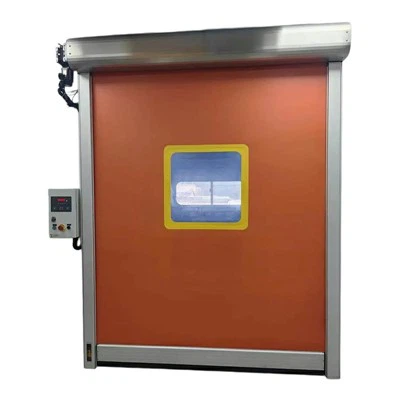
If you’re tired of slow, clunky doors that take forever to open, or if you’re dealing with a high-speed door that’s vibrating too much and causing wear on your equipment, hit us up to chat. We can send a tech to your site to check your current door, or help you pick out a new door that fits your space and keeps vibration at a level that works for your operation. No sales pitch, just real answers to whatever questions you have.
High-Speed Rolling Door References
- Industrial Door and Access Systems Manufacturers Association (DASMA). (2022). Performance Standards for High-Speed Rolling Doors.
- American Society of Mechanical Engineers (ASME). (2021). Vibration Control in Industrial Equipment and Structures.
- National Institute for Occupational Safety and Health (NIOSH). (2020). Vibration Guidelines for Industrial Facility Design and Maintenance.
Suzhou Denasi Intelligent Technology Co., Ltd.
As one of the leading high-speed rolling door manufacturers and suppliers in China, we warmly welcome you to buy discount high-speed rolling door for sale here from our factory. All products are with high quality and competitive price. Contact us for quotation.
Address: No. 898 Jinsheng Road, Jinjiaba, Lili Town, Wujiang District, Suzhou City, Jiangsu Province
E-mail: ChinaDenas@163.com
WebSite: https://www.densiclean.com/
